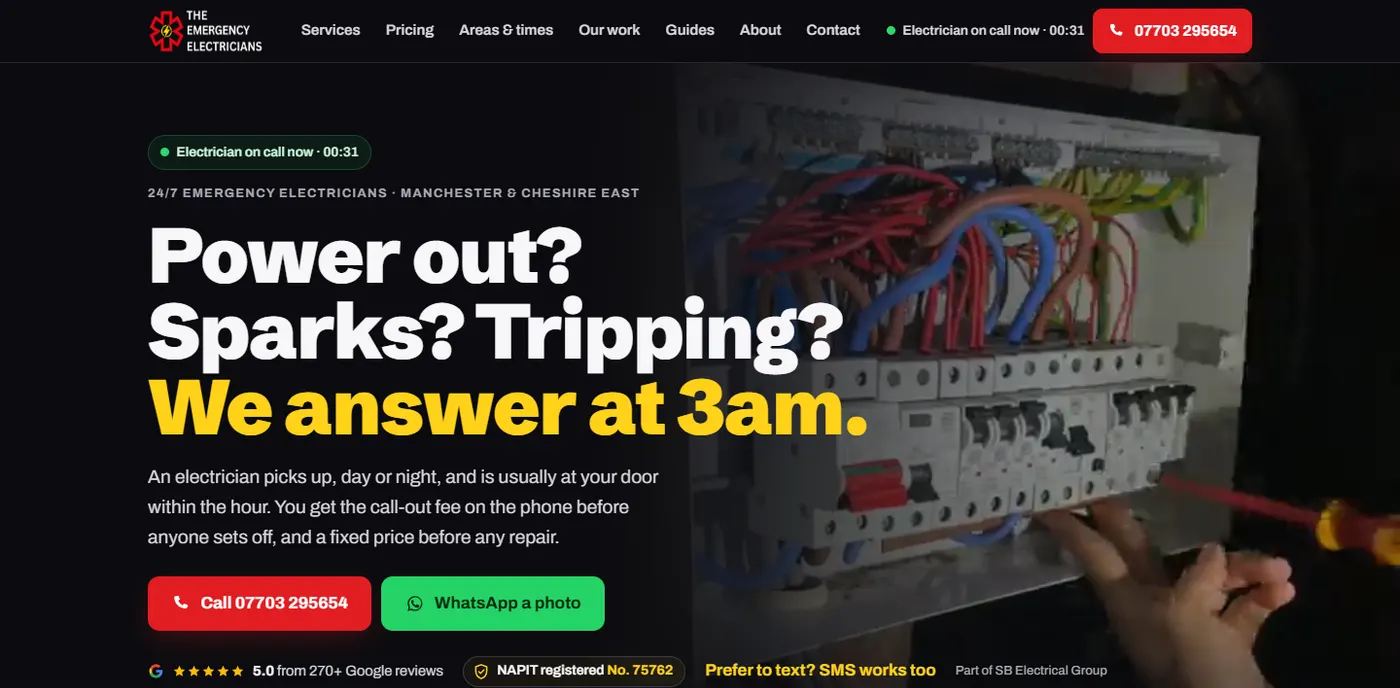
A website for an electrician costs £499 to £999 one-off with Own The Job. Starter gives you up to 5 pages. Standard sets up your Google Business Profile and adds a page for each main service, such as fuse boards, EICRs, rewires and EV chargers. Local adds a page for every town you cover.
We build for electricians outside Greater Manchester only. Inside it, our own electrical firms would be competing with you for the same searches. More on that.
What people search for when they need an electrician
Nobody searches for an electrician in the abstract. They search for the thing that has gone wrong or the certificate someone has asked them for. Each of those is a page, with its own heading, its own price guidance and its own way of getting a call started.
Fuse board and consumer unit
The highest value planned job most domestic electricians do. It needs its own page explaining what a modern board does, why an old one gets flagged and what a typical replacement involves.
EICR and landlord certificates
Landlords and letting agents search for the certificate by name, often under a deadline. The page states what an EICR covers, what a C1 or C2 result means and how quickly you can attend.
Rewires and part rewires
A long decision with a big number attached. This page carries the most photographs and the clearest explanation of what happens to the house while the work runs.
EV charger installation
A growing search with a grant and a regulation attached. Buyers want to know which chargers you fit and whether you handle the paperwork.
Emergency and no power
Written for a phone held one-handed in the dark. The number is the first thing on the page, hours are stated plainly and there is nothing to scroll past.
Commercial and landlord work
This buyer needs a different tone. Facilities managers and agents want scope, certification and response times more than reassurance about tidiness.
What your work photographs like
Electrical work photographs better than most trades believe, because you can see the before and after. A tired board next to the replacement does more selling than any paragraph.
Before and after boards
The single most useful photograph you own. We ask for pairs, shot from the same angle and lay them out so the difference reads instantly.
Certificates and test sheets
A photographed test schedule proves you document properly. We crop out names and addresses before anything goes near the site.
Van and uniform
One decent shot of the van outside a normal house does more for local trust than a stock image of a socket ever will.
Phone photos are fine
We correct exposure and straighten what needs straightening. We do not need a photographer and we will tell you if a photo can't be used.
The registers that matter
Registration is the fastest proof you have. We put it where the decision is made rather than burying it in a footer strip.
- NICEIC: shown in the header and repeated on the EICR and fuse board pages, with your registration number.
- NAPIT: treated identically. We use whichever scheme you actually hold, never both for effect.
- ELECSA: included where held, with the certification body named in plain words for buyers who do not know the acronyms.
- SELECT: for work in Scotland, shown the same way.
- Part P and building control: explained in one sentence on the fuse board and rewire pages, because customers ask what it means.
Builds we have done that suit electricians
Three of our builds are electrical firms we run ourselves. The Emergency Electricians takes emergency callouts, Wired & Certified does planned domestic and commercial work and Fuse Box Fitters sells one service at three fixed prices. Between them they cover most of what an electrical firm needs.